
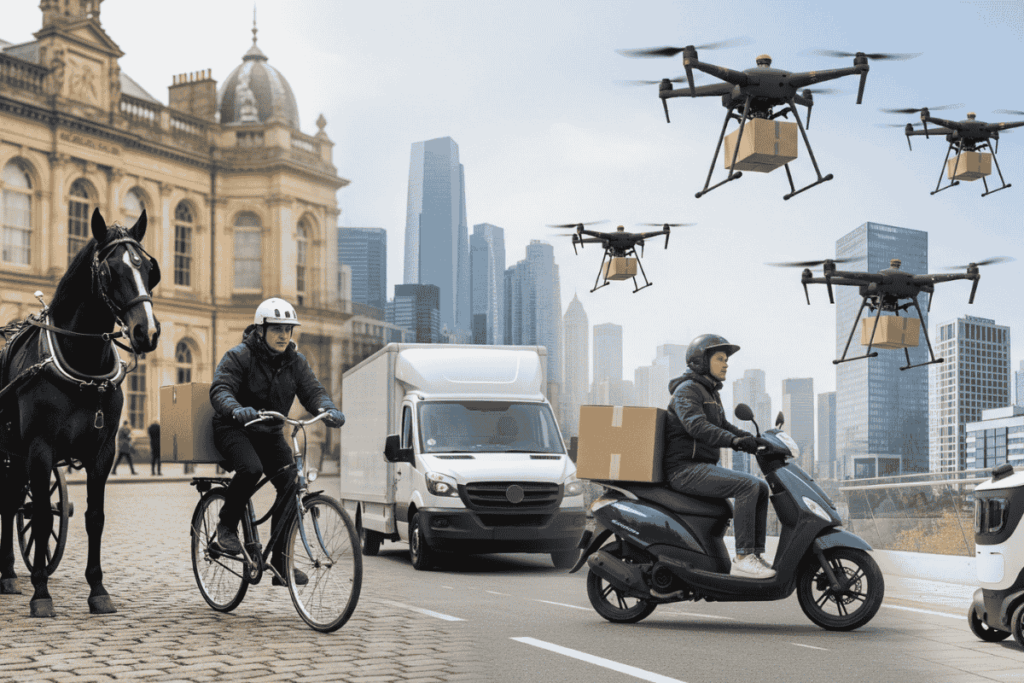
The idea of same-day delivery isn't new — humans have been finding ways to move important items quickly for centuries. Here's a look at the fascinating history of fast delivery and how it evolved into today's on-demand courier services.
Ancient origins
Long before modern logistics, ancient civilisations developed systems for rapid message delivery. The Persian Empire's Royal Road used a relay system of riders to carry messages across vast distances in days. The Roman cursus publicus enabled rapid communication across the empire. These early "same-day" services were limited to messages and small items, but established the fundamental model of fast, reliable delivery.
The messenger era
In the 19th and early 20th centuries, bicycle messengers and telegraph boys provided rapid delivery services in cities. These human-powered couriers could navigate urban areas faster than horse-drawn vehicles and became essential for business communications and time-sensitive deliveries.
The rise of professional courier services
The post-war economic boom created demand for reliable, professional courier services. Companies specialising in fast delivery emerged, initially focusing on business-to-business document delivery and growing to serve a wider range of customers and item types.
The digital revolution
The internet transformed courier services. Online booking systems, GPS tracking, and mobile apps made it possible to book and monitor deliveries with unprecedented convenience and transparency. The rise of e-commerce created massive new demand for fast delivery.
The platform economy
The 2010s saw the emergence of courier platforms like Zoom2u that connected customers directly with independent couriers, similar to how Uber connected passengers with drivers. This model dramatically expanded the capacity and reach of same-day delivery services.
The drone and autonomous vehicle frontier
Today, drone delivery is being trialled in Australian cities, and autonomous delivery vehicles are being tested globally. The next chapter in same-day delivery history is being written right now.